General Procedure
To export dairy products outside the European Union, the entire production chain must be under the supervision of COKZ or the Netherlands Food and Consumer Product Safety Authority (NVWA). If the production chain is supervised by COKZ, the production company will be assigned an approval number (Z-number).
To apply for export certificates, the products must be registered under one of the export programmes. The export controls carried out by COKZ are based on the supervisory pyramid, as shown in Figure 1.
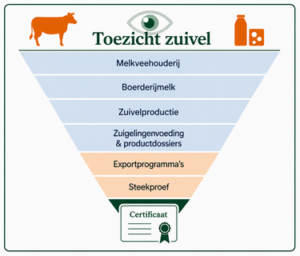
Figure 1: Supervisory Pyramid
If products that are prepared under the supervision of COKZ are being exported, they must be registered in the relevant product category. If foreign raw materials are used in the products, you also need to report this; there is a separate export program for that. More information about the above procedures can be obtained from the Data Processing department.
COKZ Export Programmes
To ensure reliable information for the issuance of export certificates, the COKZ has established export programmes, see Table 1. These export programmes apply to Dutch dairy products, specifically for products prepared under the supervision of the COKZ. A separate export programme is available for foreign raw materials.
There are also country programmes for export to specific destinations such as Algeria, Brazil, and China to guarantee compliance with additional specific country requirements.
Table 1. COKZ Export Programmes
Name | Appendix |
Butter | 1.1.1 |
Milk fat | 1.1.2 |
Butter products, other than butter and milk fat | 1.1.3 |
Cheese at the cheese factory | 1.2.1 |
Whole and cut cheese at subsequent processors | 1.2.2 |
Grated cheese | 1.2.2a |
Processed cheese, processed cheese powder, and cheese powder | 1.2.3 |
Quark/fresh cheese | 1.2.4 |
Products prepared by curdling non-milk fat and subsequent ripening at the factory, the ripening plant, and the processors
of the grated and cut product | 1.2.5 |
Products produced by small-scale dairy producers | 1.2.6 |
Milk powder | 1.3.1 |
Whey powder | 1.3.2 |
Powdered milk products (other than milk powder, whey powder) | 1.3.3 |
Evaporated milk | 1.4.1 |
Sweetened condensed milk | 1.4.2 |
Pasteurised drinking milk and liquid milk products based on pasteurised milk | 1.4.3 |
Sterilised or UHT-treated drinking milk and liquid milk products based on sterilised or UHT-treated milk | 1.4.4 |
Milk-based ice cream | 1.4.5 |
Raw or thermised, respectively pasteurised (supplementary) milk | 1.4.6 |
Special dietary foods | 1.5 |
Foreign raw materials | 2 |
Algeria | 3.2
Application for inspection |
China | 3.3 |
Brazil | 3.4 |
India | 3.5 |
The following certificates are available through the COKZ:
Veterinary certificates
In a veterinary certificate, the Dutch government (NVWA) provides a number of statements concerning the nature of the product and the veterinary conditions (animal diseases) under which the product was prepared. In the Netherlands, these veterinary certificates are issued by the Netherlands Food and Consumer Product Safety Authority (NVWA).
When such statements are required for dairy products, the application can be submitted to COKZ. Under an agreement, working arrangements have been established between COKZ and NVWA for the issuance of export certificates for dairy products intended for human consumption. An NVWA veterinarian is present at COKZ every day to issue these certificates.
Health certificates
In a standard health certificate, the Dutch government certifies that a particular product is fit for human consumption and has been prepared under official supervision. In the Netherlands, COKZ is authorised to issue health certificates for Dutch dairy products. Some of these certificates are issued on behalf of the Ministry of Agriculture, Fisheries, Food Security and Nature (LVVN). Standard health certificates are issued by COKZ on behalf of the Dutch government or on behalf of COKZ itself.
In addition to standard health certificates, COKZ can issue various specific certificate clauses for Dutch products (e.g. concerning dioxins, free sale and radioactivity). COKZ also carries out various checks for this purpose.
Registration certificates
The COKZ can issue so-called registration certificates for the registration of a company and/or product(s) in a third country. These certificates only contain information about the company and/or product(s); no shipment details, such as batch numbers, transport details, etc., are included. Registration certificates are requested directly from the COKZ and are not processed through the NVWA’s digital system (e-CertNL).
Applying for Certificates
Certificates are applied for through the online portal e-CertNL. The procedure for obtaining a certificate can be found here:
The e-CertNL system is managed and maintained by the NVWA. Through this system, both dairy certificates and certificates for other product groups can be requested.
To apply for export certificates, the following steps must be completed:
- Applying for eHerkenning: To log in to the e-CertNL system, eHerkenning is required, with a minimum security level of 2+: https://www.eherkenning.nl/
- Introductory meeting: To process applications, the COKZ must create a customer code. Before creating the customer code, an introductory meeting is scheduled with the applicant to discuss the process.
- In addition, the exporter must demonstrate that the storage facility and/or trader, where applicable, is registered with the COKZ or NVWA.
For more information about the issuance of export certificates, please contact the Export Certification Department.
Contact Details
Export Certification Team:
More information
More information about applying for certificates can be found at the following link:
Frequently Asked Questions
The legislation regarding the notation of the approval number has changed. What do I need to do and when?
The legislation relating to this matter (Regulation (EC) No 853/2004) has already been published (9 May 2024). You may therefore switch to using the identification mark with EU immediately. Regulation (EU) 2024/1141 specifies the transitional period. It provides that the abbreviation EC may be used in the identification mark until and including the production date of 31 December 2028. The EC and EU designations are considered equivalent by the NVWA and COKZ. If there is a difference in the EU/EC designation between the packaging and the certificate, this will not be considered an error. However, COKZ cannot guarantee how third countries will interpret any discrepancy between the certificate and the packaging.
As of now, you may also enter the recognition number (Z1234) in the approval number field on the certificate. Previously, the identification mark was entered here (NL-Z1234-EC/EU). It is advisable to consult with your importer and/or the NZO Market Access Team before changing your standard notation.
For more specific information about the changes relating to the identification mark, the use of the approval number, and what this means for your registrations in third countries, please contact the Dairy Market Access Team of your trade association, NZO.
Email address: markttoegang@nzo.nl
Further information on this subject can already be found in NZO Newsletter No. 2026-015, dated 30 June 2026, available here:
Amendment to identification number | PDF
What is the role of the COKZ in the export of dairy products?
The COKZ oversees the entire dairy supply chain in the Netherlands. Products bearing an NL approval number must be registered with the COKZ under the relevant “affiliation module” to be eligible for certification. As a result, no sampling is required at the time of shipment. For the export of foreign dairy products, please contact the Export Certificates Department.
Which terms are used on the certificate to indicate the location?
Storage location: The location where the product is stored and loaded. This location must be registered or approved by the NVWA or the COKZ.
Inspection location: The location where the product is made available for inspection by the inspector. This location does not appear on the certificate; however, it is specified in the procedure and is automatically populated based on the designated storage location.
Place of departure: The location that appears on the certificate. Enter the storage location here.
Can a shipment still be certified if it has already left the Netherlands?
No, unfortunately, this is not possible. The basic principle of remote certification is that the products must be located in the Netherlands at the time of certification. This means the moment when the company submits the certificate for printing (i.e. the print date shown on the certificate is decisive).
Please note: COKZ and NVWA perform a number of final checks on the printed certificate.
How is the quality of dairy products guaranteed?
To ensure the quality of products intended for export, COKZ oversees the entire supply chain.
Only products from a location with an approval number (Z-number) and products that are registered with COKZ under the affiliation module can be certified. As a result, exports can take place without interfering with the logistics process and without an export inspection of the products being carried out at the time of shipment.
For the export of foreign dairy products, please contact the Export Certificates department.